

Key Takeaways
Most marketing still works by interruption. It shouts at people who never asked to be shouted at, then wonders why conversion rates stay flat and unsubscribe rates climb.
Seth Godin identified this problem back in 1999 when he introduced permission marketing: the idea that the most effective marketing only reaches people who have actually agreed to receive it. Remarkably, this aligns perfectly with a principle that European data protection law would later enshrine as a legal requirement: Privacy by Design.
Prefer to watch the overview on Privacy by Design & Marketing?
For businesses operating in Spain under both the GDPR and the LOPDGDD, this isn't just a philosophical alignment. It is a practical roadmap. When you build your marketing around genuine consent, you don't just satisfy regulators, you build a more engaged audience that actually wants to hear from you.
Permission marketing is the practice of sending marketing messages only to people who have explicitly agreed to receive them. Seth Godin defined it as the privilege, not the right, of delivering anticipated, personal, and relevant messages to people who want to get them.
This stands in contrast to interruption marketing, which relies on billboards, cold emails, and pop-up ads to grab attention by force. Godin’s framework rests on three core principles:
The result is a shift from broadcasting to everyone to cultivating an audience that actively chooses to listen.
Privacy by Design is a framework codified under Article 25 of the GDPR. It requires organisations to embed data protection into every stage of a business process rather than bolting it on as an afterthought.
Under the GDPR and Spain's LOPDGDD, Privacy by Design means your marketing must prioritise:
In Spain, the AEPD enforces these principles actively. Sanctions for non-compliance can reach €20 million or 4% of global annual turnover, making compliance a business-critical priority.
The overlap between Godin’s philosophy and legal requirements is striking. Both respect the individual’s autonomy over their own attention and data.
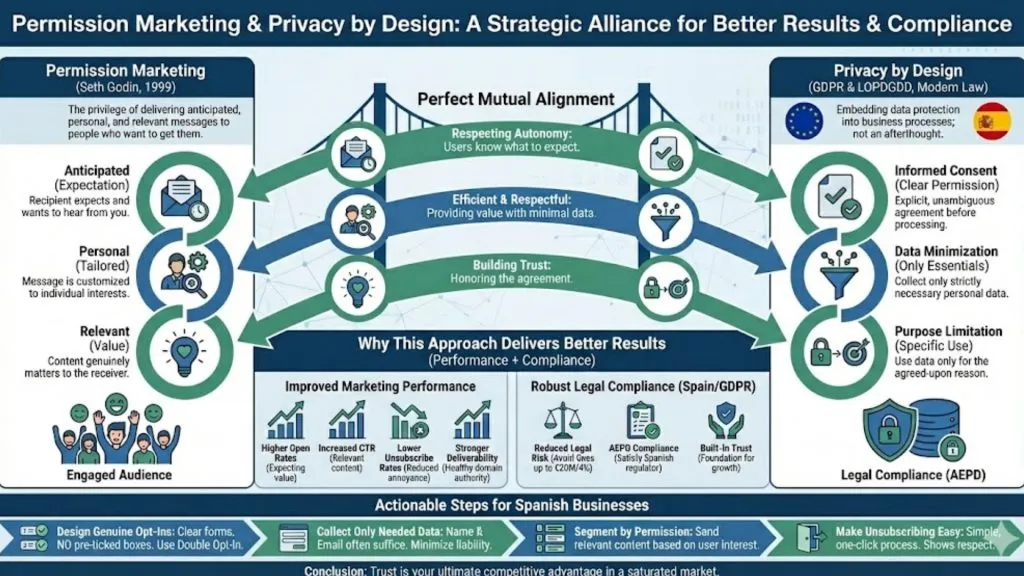
This isn't just about compliance, it is about performance. When someone has genuinely opted in, every key marketing metric improves:
Godin compares this to dating: you don't propose on the first meeting. You earn trust gradually, moving the person up the permission ladder from stranger to advocate.
In a market saturated with interruption tactics, trust is a competitive advantage. This is especially true in sectors like finance, legal services, and healthcare, where a Data Protection Officer is often required.
The businesses that thrive won't be the ones finding clever ways to skirt consent. They will be the ones that make consent the foundation of their growth. To learn more about how data protection works in Spain, explore our guides and articles.
Is permission marketing required by the LOPDGDD in Spain? Yes. The LOPDGDD and the GDPR strictly require informed, unambiguous consent before processing personal data for direct marketing purposes, effectively making permission marketing a legal mandate.
Does a pre-ticked box count as permission under the GDPR? No. Pre-ticked boxes do not constitute valid consent. Consent must be a freely given, specific, and affirmative action by the user.
How does data minimisation apply to email marketing?Data minimisation requires that you only collect the personal data strictly necessary for your marketing goal. For a newsletter, this typically means asking only for an email address, rather than demanding a phone number or physical address.
Informational Purposes Only: The content provided by ANRO DIGITAL SOLUTIONS S.L.U. (including resolution summaries, infographics, and case analyses) is for educational and informational purposes only.
No Legal Advice: This information does not constitute legal advice, a formal legal opinion, or a substitute for professional legal counsel. The interpretation of data protection laws (including the GDPR, LOPDGDD, and AEPD resolutions) is subject to change and can vary based on specific facts and circumstances.
No Liability: ANRO DIGITAL SOLUTIONS S.L.U. assumes no responsibility or liability for any actions taken, or not taken, based on the information provided on this website. While we strive for accuracy, we make no guarantees regarding the completeness or timeliness of the information.
Consult a Professional: Data protection compliance is a complex legal requirement. You should not act upon this information without seeking advice from a qualified Data Protection Officer (DPO) or a specialist data protection lawyer licensed to practice in your jurisdiction.
Third-Party Links: Links to official AEPD documents are provided for convenience. We are not responsible for the content or availability of these external government portals.
Este resumen tiene carácter meramente informativo. Para más información, consulte nuestro Aviso Legal.